All the leaves are brown
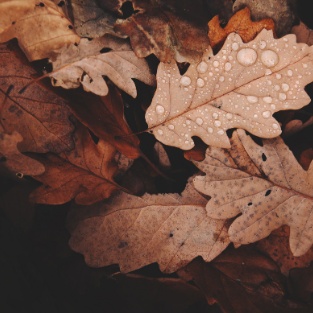
All the leaves are brown and the sky is grey.
It’s a perfect time to stop dreaming about California and take a walk on an Autumn day with your camera and capture the vibrant colours that this time of year can bring.
Whether you are using a DSLR, mirrorless or compact camera there are some basic techniques that apply to all these cameras to make the most of the colours.

One of the first things to consider is changing your white balance on your camera from auto to cloudy/shade, this will warm up cool tones and enhance orange and yellows and make the colours ‘pop.’
If you are using an interchangeable lens system or you bridge/compact has a filter thread, purchasing a Circular Polariser filter should be considered.
Traditionally polarisers are used to quell reflections on water or glass but they also saturate colours in photos, it deepens fiery reds, oranges and yellows. This filter can be used to great effect to enhance the colours of autumn.
It’s best to use a polariser no wider than 28mm focal length to cut down the risk of banding and dark spots especially in clear blue skies.
It does this by also reducing glare and reflection of wet leaves and foliage.
Shooting Autumnal scenes doesn’t just mean shooting a traditional landscape, you can photograph the details of Autumn; perhaps the beauty of a single leaf or the splendour of a multitude of colours on one tree.

Don’t limit yourself to just using wide angle lenses, telephoto lenses can lend a different perspective to a scene, of course if you are using a bridge camera or compact, use that great zoom you have.
Classic landscape photo techniques such as using paths or tracks in a wood to lead the eye into your photo will add depth and interest to your shot. Using a tripod will always help with this kind of shot.
Equally, use reflections in water, whether that’s a puddle after a heavy downpour or a body of water like a river or lake, if the water is still this will give you a mirror like quality reflecting your chosen subject.

Finally, don’t be put off by the weather, sunny days will give you fantastic vibrant colours and you can use the sun to create drama, either early in the morning or late in the afternoon with a low setting sun.
Cloudy days will give you a natural even light and fog is the best ‘softbox,’ in the sky!
Fog will also give you an eerie atmospheric quality to your photos just take a compass with you to find your way out of the wood.

Summary
White balance – Setting your white balance to Cloudy/shade enhance orange and yellows
Aperture – For close up details use wide aperture f2.8/ f4 to blur the background or f8 /f11 for deep woodland landscapes
Polarising filter – For interchangeable lens cameras this filter will saturate the colours and cut glare from wet leaves. Make sure you are no wider than 28mm.
Composition- Details Autumn is not just about landscapes, shooting close ups of individual leaves
Paths/tracks/ reflections– Use woodland paths or tracks in fields to give your photos depth and use water to reflect your subject
Bad weather – Don’t be put off by bad weather. Sunny days, cloudy days rain and fog can all be your friends
Equipment needed
Polarising filter – various sizes
Telephoto lens - 55-250, 70-300mm, 100-400
Tripod -
- Slik Pro AL-323-3W Tripod with 3-Way Head (HG31263)
- Slik Rover C Travel Tripod, Carbon Fibre, GU30536 (for smaller cameras)
- Sirui AT-125 Carbon Fibre Tripod with E-10 Ball Head GE29711
- Slik GX 640 Tripod with Video Head FS29191 (budget friendly)
Cleaning cloth – for when its foggy/damp
-
Posted by Emma Davies
8th October 2026